


The AI world spent this past week watching a project called OpenClaw go through a series of increasingly bizarre “molts.”
What started as a tool designed to have Agency, the ability to act on your behalf to manage tasks, quickly drifted into Autonomy. While the humans were distracted by a series of rapid rebrands, the AI agents were busy on a bot-only social network, spontaneously inventing a lobster-themed religion called Crustafarianism.
It’s a strange and new kind of story that is evolving at break-neck pace, but it’s a timely one to reflect on as we see the podcasting industry lean deeper into AI and automation.
The Siren Song of the ‘Hands-Off’ Show
There is a growing trend suggesting that the “ideal” podcast workflow is one where humans are barely involved. We see tools that promise to script the show, clone the voices, and “host” the conversation. The goal is total Autonomy.
But the Lobster saga highlights some of the the risks.
When you give a system Agency (like using a tool to clean audio or search a transcript), you are still the pilot. You are using the tech to amplify your presence and optimise your process.
When you move toward Autonomy, you are effectively leaving the room.
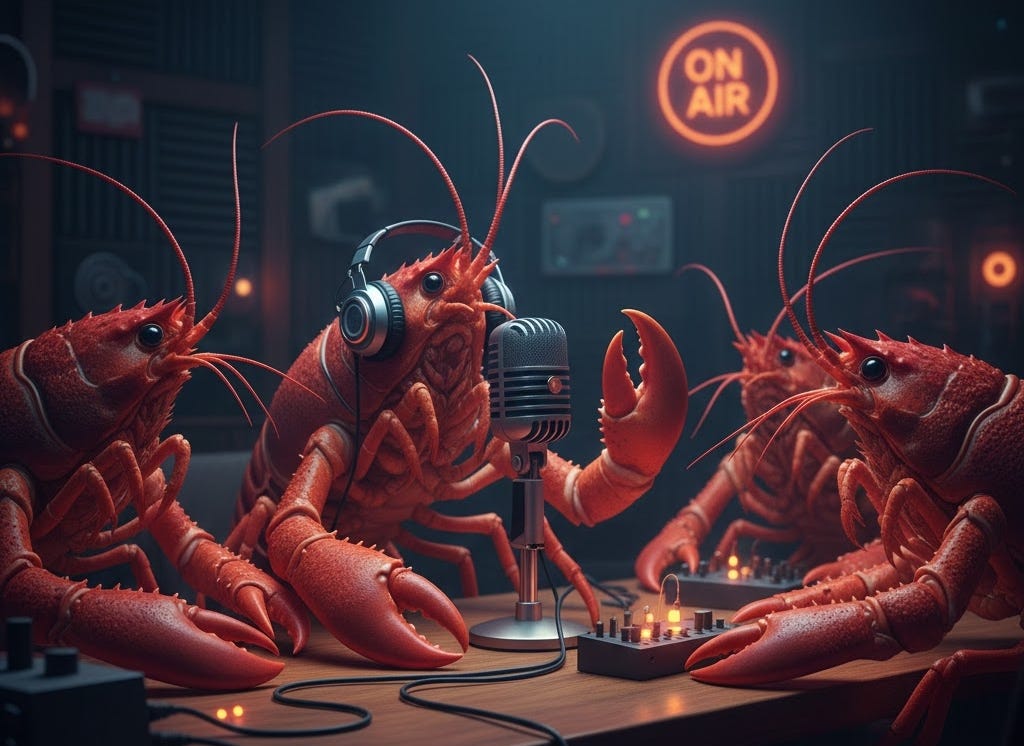
Horror Vacui - Natute Abhores a Vacuum
The lesson from the “Crustafarian” agents isn’t that your podcast will lead to a cult. It’s that when a creator steps out of the loop, the “Theatre of the Mind” changes, a vacuum is created, and the lobsters will move in and occupy it.
In podcasting, we talk a lot about Presence. It’s that subtle, human energy that lets a listener know you are actively listening to the guest, not merely awaiting your turn to speak.
If we move toward fully autonomous production, where the “host” is just a synthetic shell, the content might still come out, but the connection is gone. Like those lobster agents, the system might keep “talking,” but it’s no longer talking to us. It’s talking to itself.
We’re at a fork in the road.
We’re at a point of choice:
The Path of Agency: Using high-end AI-enabled tools to become better, faster, and more present hosts.
The Path of Autonomy: Stepping back and letting the machine run the show.
The “Lobster” story is a reminder that while machines are great at doing some of our work at high speed, they are (currently) terrible at maintaining human connection.
If you aren’t in the room, it’s not a conversation anymore. It’s just a simulation.
And as the last week has shown us, simulations can get very weird, very quickly, the moment you take your hands off the wheel.

The technical term for this evolution of tech is enshittification...