


In the world of Monty Python, Eric Idle’s leering “Man in the Pub” famously declares: “A nod’s as good as a wink to a blind bat, eh? Say no more!”
It’s a delightful bit of absurdity, though in the podcast studio, it’s actually profound. When we’re recording, a nod is as good as a wink, since neither of them makes a sound.
Affirm visually is a recurring piece of #SoundAdvice we offer our clients.
It sounds counter-intuitive for a medium built on the spoken word, but the best hosts are often the ones who know when and how to become invisible and inaudible.
When you’re recording a conversation, your natural instinct is to be a “good” conversationalist. In the real world, that means a constant stream of audible bridge-building, those “Mmm-hmms,” “Rights,” and “Absolutelies” we use to prove we’re still awake and paying attention.
But a podcast isn’t a coffee shop chat. It’s a piece of theatre.
The Theatre of the Mind
Imagine your listener has their eyes closed, earbuds in. In their mind’s eye, they are sitting right there with your guest. They are hanging on every word, every breath, and every thoughtful pause.
When you interject with a verbal affirmation, you’re not “supporting” the guest; you’re effectively walking across the studio in the middle of a monologue, tapping the listener on the shoulder and saying, “Hey, don’t forget I’m here, too!” It shatters the intimacy. It breaks the spell. (And yes, it makes your editor want to pull their hair out, but that’s a minor detail compared to the listener experience.)
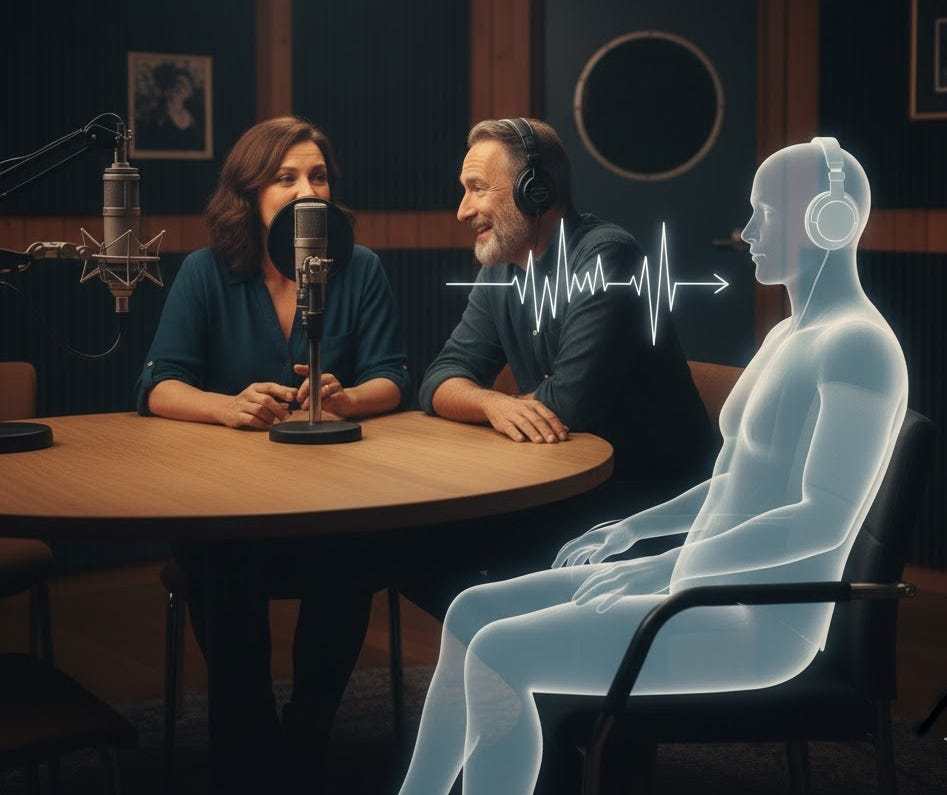
Use Your Face, Not Your Throat
Whether you’re sitting across from someone in one of our studios or chatting via a remote link, you should practise your visual cues like:
The exaggerated nod: which says “I’m with you” without a single decibel;
The widened eyes: “That’s incredible” without stepping on their punchline; and
The leaning in: It tells the guest they have your full attention, giving them the “sonic space” to dive deeper.
By using your face instead of your vocal cords, you leave your guest centre stage to be brilliant, while leaving the audio landscape wide open for the listener.
Your job as a host isn’t to be the star of the show. It’s to provide the backdrop so the actual stars can shine.
Say no more.

Brilliant breakdown of the invisible host principle. The theatre metaphor really clicks because most podcasters dont realize they're directing the listener's mental movie scene by scene. I've noticed this in some of my favorite interview shows where dead air actually amplifies tension in the best way. Once I started muting myself during intense moments it felt awkward at first, but guests instantly went deeeper with their responses.