


Perhaps it’s because Spring has sprung and the grass is riz that I find myself musing* over how we sometimes name a thing by what it isn’t?
Wireless. Horseless. Cordless. Sugar-free.
The thing that was taken away is the only thing in the name... which means it never really left. Call it the ‘ghost’. Every one of these names has one, and the trick is to watch which side of the room the ghost is on.
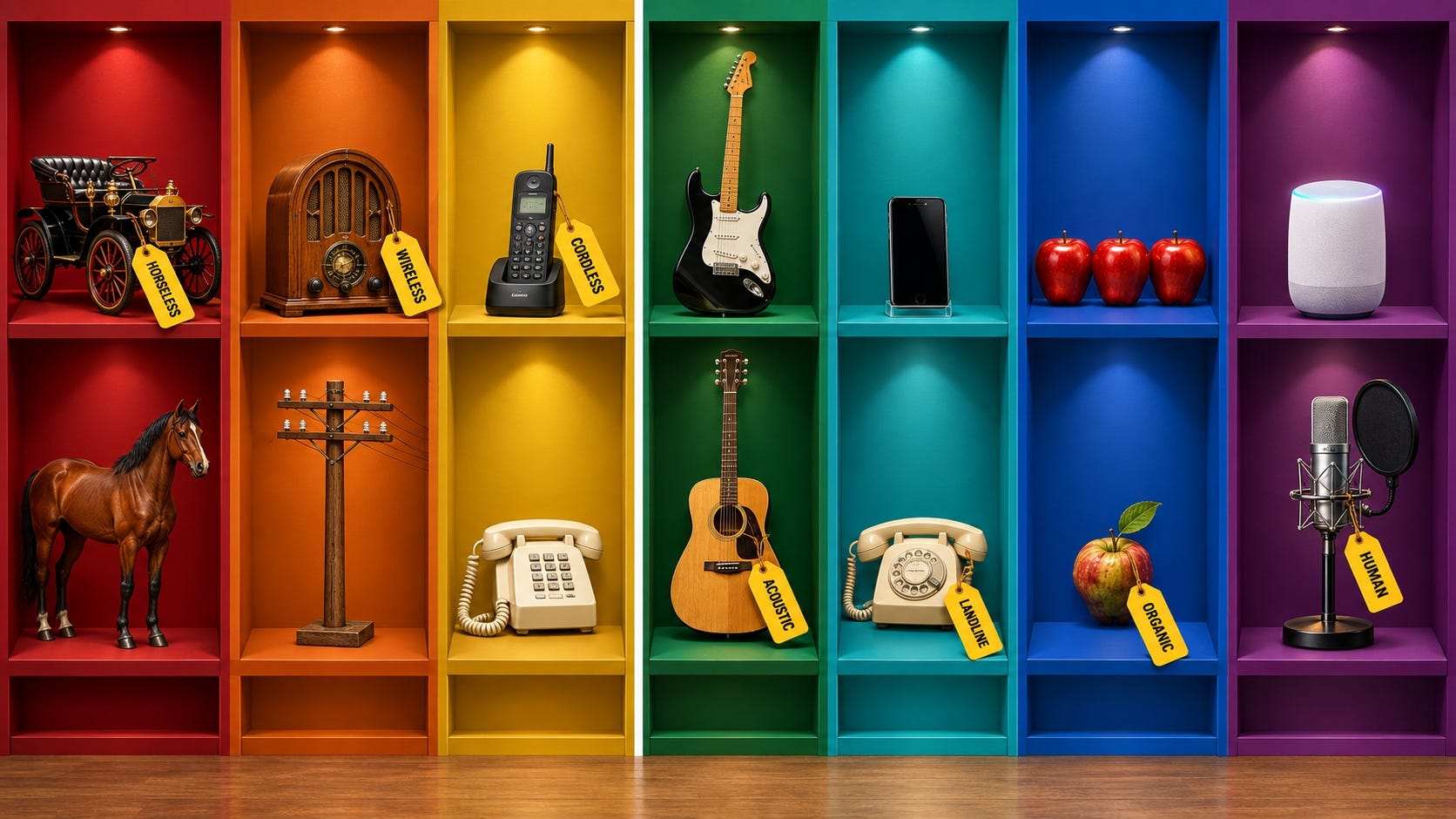
Follow the name tags. On the left they hang on the new invention. The horse is gone, but it haunts the car. The wire haunts the radio. That’s the ghost of the past, clinging to the future.
Now cross the white line and watch the tag jump. Acoustic. Landline. Organic. The electric guitar needs no tag... it became the default, so the ghost changed sides and moved into the wooden one. Linguists have a word for this second kind: a retronym, a name the old thing only gets once the new thing has won.
Nobody said “acoustic guitar” in 1930. Nobody needed to.
Aristotle got here first (he usually did). His word was privation: you can only call a thing blind if it’s the kind of thing that’s supposed to see. So a carriage can only be horseless while carriages are expected to have horses. And a guitar can only be acoustic once guitars are expected to plug in. (Spinoza, centuries later, boiled the whole idea down as: ‘to define is to negate’.)
Which makes the tag a clock. The moment the old thing wears the negative name, the default has already flipped. Not “is flipping”. Flipped. The name arrives after (to really mix my metaphors) the horse has bolted.
* Last week it happened in real time. The band Muse had always been @muse. Then Meta launched an AI called Muse, and the band is now @museband. Not the AI. The band!! The humans got the tag. (Yes, the ones who wrote a whole album about the machines winning. You can’t make this up.)
Now look at the last one on the right. That one’s ours.
Two years ago nobody wrote “human-narrated” on an audiobook. Nobody wrote “real conversation” on a podcast. Then Audible started printing "Narrated by: Virtual Voice" on its listings (forty thousand titles and counting), the Audio Publishers Association wrote a naming guide for the new kind, and "human-narrated" quietly appeared as a word the trade needed...
…and there it was. A brand new retronym, in our own back yard. The ghost in “human” is the machine, and it has only recently moved in.
Here’s the bit that keeps me up at night, but in a good way ;-)
Audio spent twenty years making humans sound like machines. Noise floor stripped. Breaths tightened. Every retake invisible. The whole craft was removing the evidence that a fallible human was in the studio. Then the machines started producing that exact clean signal for free. So the polish is worth nothing, and the only proof of a human left is the stuff we cut. The cough. The ums and ahs. The guest talking over the host.
The stuff on the cutting-room floor is the proof of authenticity.
And audio has something text never had: a witness. You cannot prove a paragraph was typed by a person. But a podcast has a second human in it, and that human exists, has a diary, and can be asked.
I don’t have this resolved. The listener still wants the clean edit, so the product and the proof are different files. The witness works right up until the witness is a clone. “Human-narrated” is self-declared... nobody audits it, which is exactly where “organic” sat for a decade before the inspectors turned up. (For a studio it’s stranger still: the polish we sell is what erased the proof, and the proof we hold is what we were paid to remove.) Hmmmm.... How to resolve this?
And what are we doing about it?
Well, we’re listening. Not for the technology... for the names. A negative name is a leading indicator. It shows up small and boring, on a listing or a label, and a year later everyone can see what it was announcing. Horseless. Wireless. Human.
Watch the ghosts. They change sides before the news does.
Confusion precedes learning.
Let’s have an adventure.

P.S. The philosophers have a word for being haunted by what’s absent: hauntology. P.P.S. Sting and the Police got there first. Ghost in the Machine and Synchronicity are both Arthur Koestler book titles. Perhaps every name has a ghost in it? Even the ones on vinyl.