


I’ve started this post four times in writing, dozens of times in my head.
Not four drafts of the same post... four different posts. Each one began with a story I was sure would carry the idea, rambled on for a few hundred words, and then quietly fizzled out when it stopped making sense. Some of them I loved. One of them nearly went out.
The question underneath all of them was simple to ask and maddening to answer:
“What happens to the people whose voices we know,
now that a voice can be digitised?”
Here’s the trail of the word-wreckage. I think it was a useful journey.
Attempt one: the wave
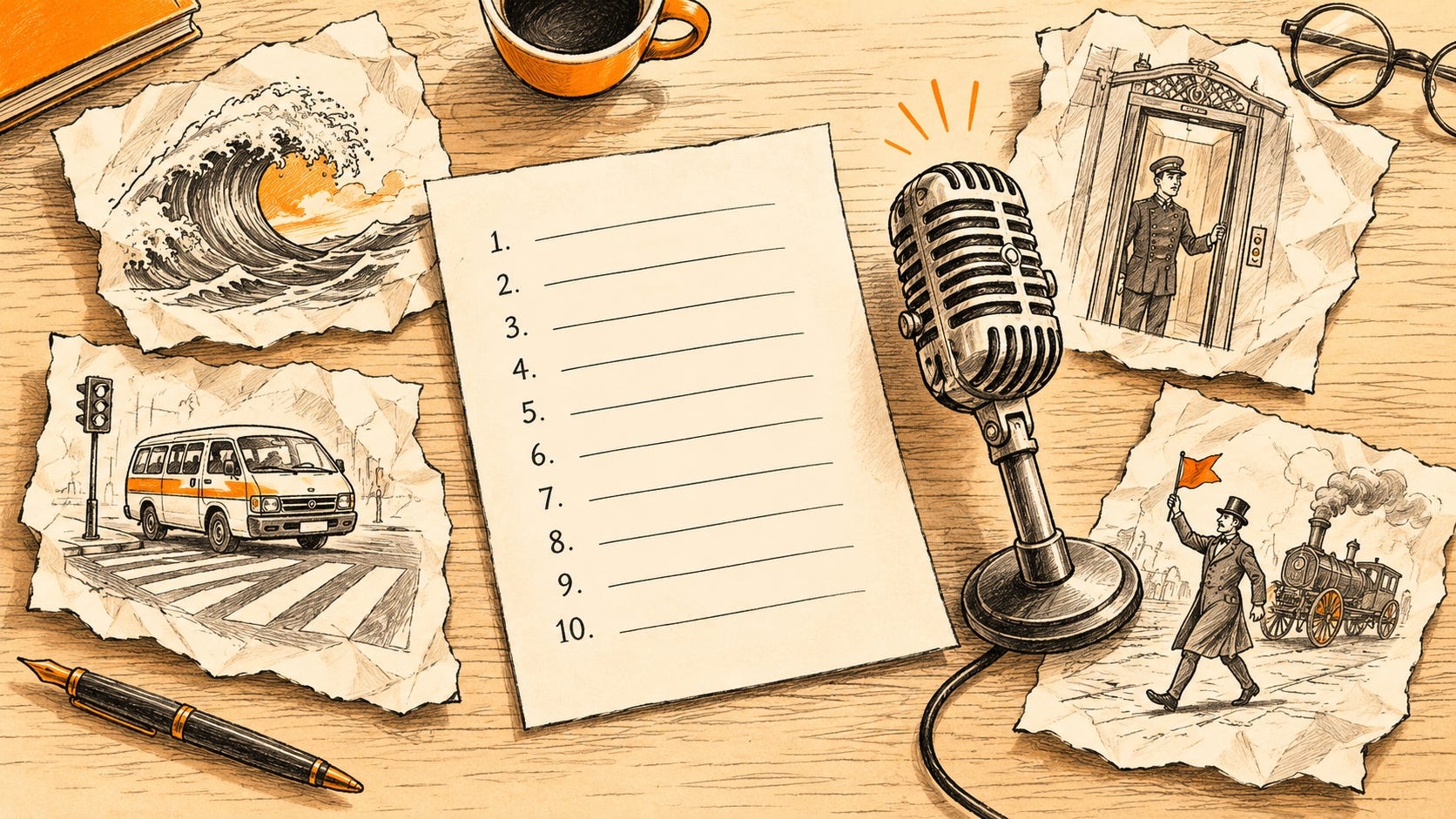
It’s the first image everyone reaches for. A big wave is coming. You can paddle out and catch it, or you can stand on the beach and get dumped. Cliché much?
I got about three paragraphs in. The trouble is that a wave doesn’t care who you are. It lifts every surfer the same, and it dumps every swimmer the same. The thing I most wanted to talk about, that a voice people know is worth something a stranger’s voice isn’t, has no place in a wave. And “catch the wave” is advice for everyone, which makes it advice for, well, no one.
Attempt two: the taxi at the green light
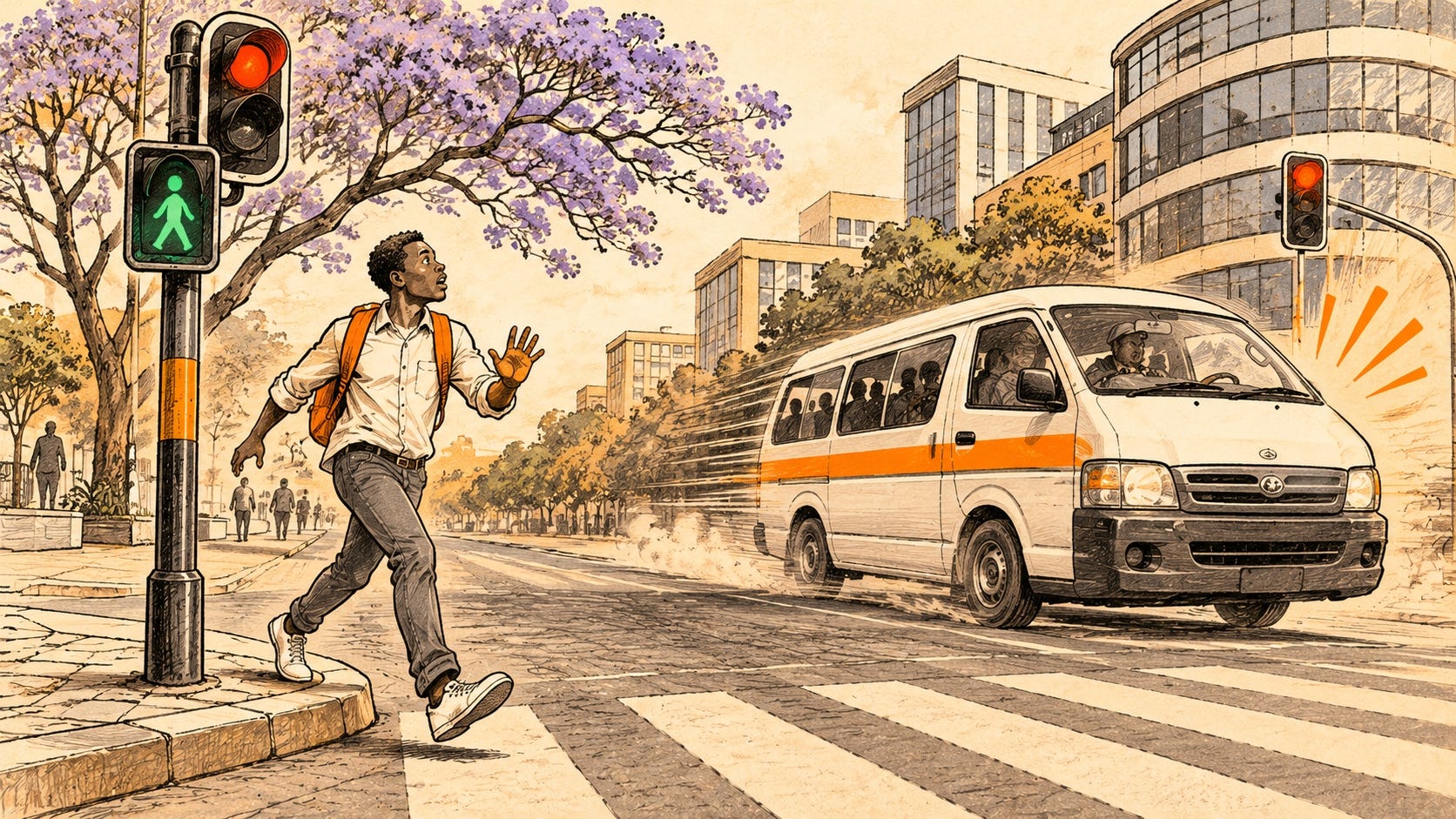
This one I liked a lot, because it’s ours. You’re at a crossing in Rosebank, the little green man lights up, you step off the kerb... and a minibus taxi comes through the red robot, hooter first. You had right of way. The road changed anyway. Look up, read what’s happening, and move.
It’s local, it’s lived, and it carried a real point: being in the right isn’t a strategy.
I wrote it twice.
And it kept going wrong in the same place. It casts the voice artist as a pedestrian and the technology as something to get out of the way of. That’s a story about survival. The more I worked on Heritage Voices, the less this felt like survival and the more it felt like... a new kind of work. A pedestrian doesn’t get a share of the taxi’s fares.
Attempt three: the lift operators
This was my favourite, and it’s a true story worth telling anyway.
In 1945, New York’s lift operators went on strike, and about one and a half million office workers couldn’t get to their desks. The automatic lift had existed since around 1900. What held it back wasn’t the engineering, it was trust: people didn’t want to ride in a box with nobody in charge. After the strike, the building owners had every reason to solve the trust problem. (Strikes tend to do that. They hand the other side every reason to try to avoid it ever happening again.)
Then, in 1954, Westinghouse put a recorded voice into the lift. The operator was gone and his voice stayed, reminding you to press your floor. Otis followed a year later. The one human thing they couldn’t do without was the reassurance, so they recorded it.
Isn’t that just a deliciously appropriate factlet?
A voice as the bridge that gets people to trust the machine.
And it stalled, because of what happened next in that story. The operator lost his job, and the recording of a voice did the reassuring for free, forever. If that’s the analogy, the ending is bleak for anyone who earns a living from their voice. It didn’t match what I was seeing in our own studio, where a familiar voice signs up, sets the rules and takes the larger share.
Attempt four: cars and the men with red flags
In 1860s Britain the law decided the motor car was a danger, so a road locomotive had to crawl through town with a man walking ahead of it waving a red flag. The rule held until 1896. By then the early car industry had grown up in France and Germany instead.
Lovely story. Clear moral:
resisting the new thing doesn’t stop it, it just decides who builds it.
I stalled on this one for a different reason. It’s a lecture. It turns everyone who’s nervous about voice twins into a red-flag waver, and most of the people I speak to aren’t waving anything. They’re veteran broadcasters (hence the name Heritage Voices) with a perfectly reasonable question: “what happens to my voice?” They deserve an answer, not a history lesson about how silly those Victorians were.
What all four had in common
Somewhere around this fourth abandoned draft I noticed the pattern, and it was a little embarrassing that I had to rely on my digital assistant (Maxwell AKA Max) to clarify the root cause.
Every analogy arrives with its ending already attached.
Choose the wave and you’ve chosen “ride it or drown”. Choose the taxi and you’ve chosen “get out of the way”. Choose the lift and you’ve chosen “the job goes, the voice stays, nobody’s paid”. Choose the red flag and you’ve chosen “resisters lose”. I wasn’t using the stories to think. I was shopping for one whose ending I liked... and then arguing backwards from it.
Confession: If you’ve ever picked a consultant because you already knew what you wanted them to say, you’ll recognise the move ;-)
So I stopped looking for a story and tried something I’ve been curious about and maybe didn’t full appreciate before.
Starting again, from what’s true
I went back to first principles. Not “what is this like?” but “what is actually true here, whatever it turns out to be like?” Small, plain statements I could defend on their own, without a metaphor carrying them.
Ten survived. Here they are:
Competent speech costs are trending to almost zero.
When one thing becomes free, value moves to what stays scarce.
A voice’s worth is recognition × trust × the right to use it.
Listeners object to deception more than to the sound.
A human’s hours are fixed; a twin frees time and allows simultaneous work.
Retailer rules are today’s limit, not the end state.
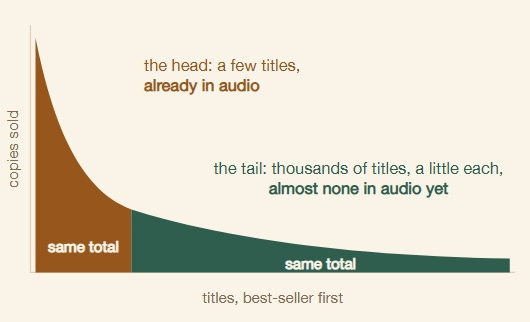
When narration gets cheap, far more books get made.
The advantage is the voices plus the care, and only if the licence is exclusive.
Stay independent of any one engine.
Listening time is fixed, so trust becomes the shortcut.
All ten are worked through, with drawings: Twin voices, from first principles.
Where that left me
Funny thing... the first principles quietly kept the best bits of every abandoned story.
The wave was right that the cost is collapsing and the flood is coming (numbers 1 and 7). The taxi was right that the rules of the road change whether we like it or not (number 6). The lift was right three times over: a voice carries trust (3 and 10), people didn’t mind a recording they knew was a recording (4), and one voice can work every lift at once (5). And the red flag was right that resisting doesn’t stop anything, it just decides who ends up owning it (number 8).
Two of the ten no story saw coming at all: that value moves to whatever stays scarce (2), and that you should never let one engine own you (9).
I’d have missed those if I’d kept shopping for analogies.
So, what happens to the people whose voices we know?
Whatever they choose, so long as they’re the ones holding the pen.
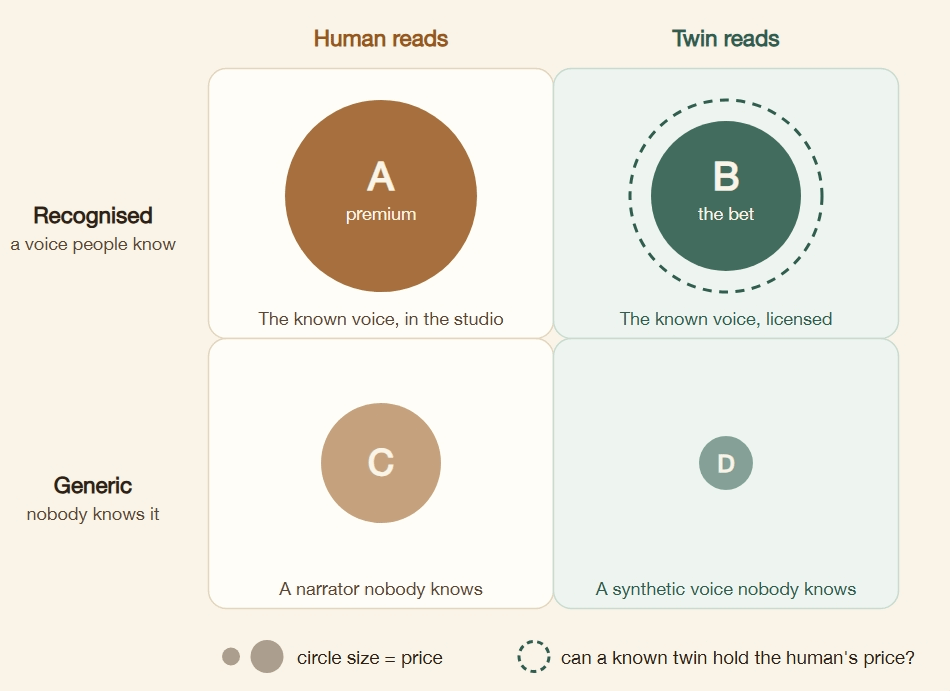
I’m far from certain where it lands. Nobody is yet, and anyone who tells you otherwise is selling you an ending. So rather than pretend, we’ve set up a thought experiment on the same page: recognised voice or unknown voice, human or twin, and what each one can charge. Then we’ll watch the catalogue, title by title, and see which square actually earns.
That’s where I’ve landed, for now. The wrestling continues.
Where have you landed on this? Let me know.
I’ll keep asking voices tough questions and keep listening for signals from the future.
Four posts started, four abandoned. This is the fifth. (Sixth if you count the taxi twice.)
“It is difficult to make predictions, especially about the future.”
- old Danish saying, often credited to Niels Bohr
If you have a voice people know and trust, drop us a mail and we can help you navigate and control your participation in this exciting future.
Let’s have an adventure.
#BeHeard #BeHuman
