


Deon Wiggett (copywriter extraordinaire, and yes, creator of the hit podcast, My Only Story) forwarded me an email last week. Reuters Institute, thirty-nine pages, fresh off the press: a properly researched survey of how the Guardian, the Economist, the New York Times, Goalhanger and a dozen others are responding to the squeeze from YouTube, Spotify and Apple. The author is Nic Newman, the same researcher who wrote News Podcasting and the Opportunities for Publishers back in 2019. Six years on, the medium has changed under his pen.
It is a serious document.
If your business is selling your audience to advertisers... read it twice.
Here’s the catch. Almost none of you following this Substack are doing that.
What Reuters actually found
Eduardo Suárez, Reuters’ Director of Editorial, distilled the report into five findings in the email that announced it. His phrase for what is happening is “uneven”: some publishers pivoting to video wholesale, others converting only chat formats, others still doubling down on audio investigations.
The five findings, briefly:
a shift from narrative series to conversational shows,
a platform-led push to video,
younger audiences who prefer to watch,
publishers embracing video cautiously, and
business models moving beyond advertising into hybrid revenue.
All five are true.
All five are true… of media podcasts.
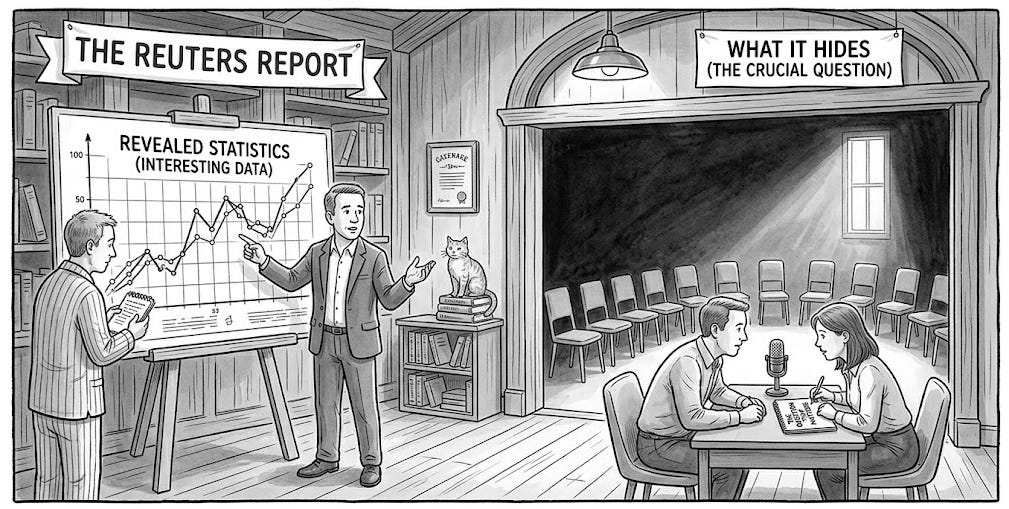
What it reveals, what it hides
There’s an old line about statistics being like bikinis: what they reveal is interesting, what they hide is crucial. The Reuters report is the same shape. What it reveals is true. What it hides is the question that matters most for your podcast:
which kind of podcast are you actually running?
The atlas, and the number it does not name
The Reuters report is a beautifully made atlas. It maps millions of listeners across thirteen publishers in three countries.
But first, a quick word on Kevin Kelly. He co-founded Wired magazine in 1993 and has been a few years ahead of the rest of us ever since. He is also one of the most quoted voices in Tim Ferriss’s Tools of Titans, which gives you a sense of the company he keeps. In 2008, Kelly published a post on his kk.org blog called 1,000 True Fans.
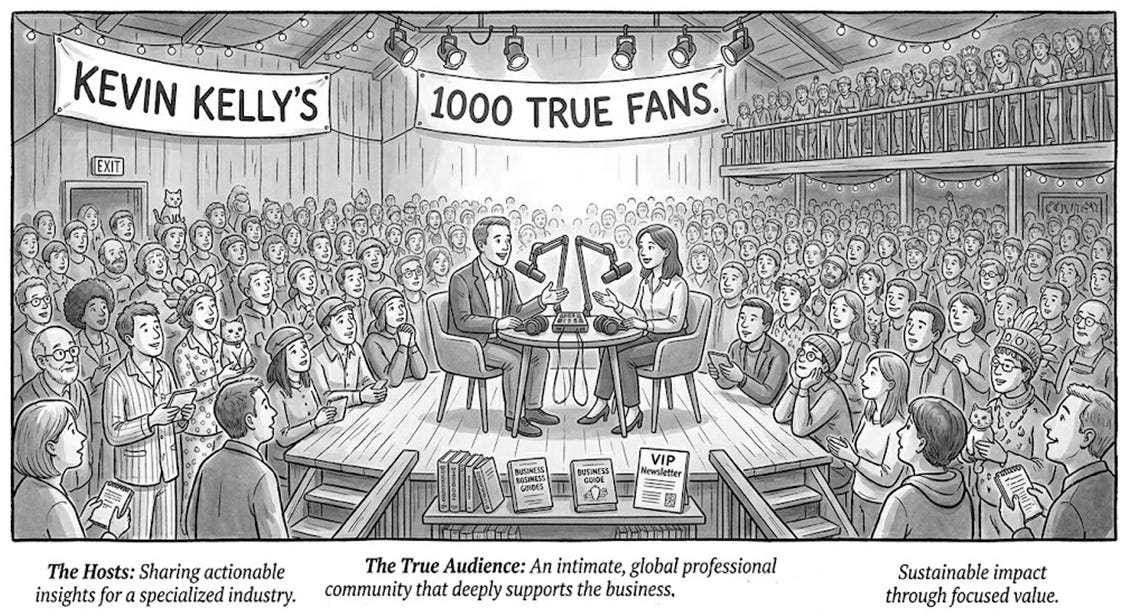
The argument was beautifully simple. A creator does not need millions of fans, just a thousand who care enough to buy anything they make. Most of Substack, Patreon, and a fair chunk of Ferriss’s own playbook (and yip, this Substack too) are built on that premise.
While Kelly was right about a thousand, most of you do not need a thousand…
you need fifteen.
That sentence is the whole post. (The rest is just showing the working.)
Three kinds of podcast
The Hobby Podcast is a labour of love. Irregular, experimental, no commercial pressure. The metric of success is “am I having fun?”
The Media Podcast, where the audience is the product and the sponsor/advertiser is the customer. Scale matters in different shapes: YouTube algorithms and ad density for some, the cultural reach of a single investigation for others. Serial sits in this lane. So does Sweet Bobby. So does Deon’s My Only Story. This is the model the Reuters report describes in close, careful detail.
The Business Influence Podcast where the audience is your customer. You are not building a media business. You are building credibility, opening doors, warming the right relationships, having the right conversations with the right fifteen people at the right time. This is the model most of our clients are running. It is also the model almost no widely-read podcast research is written for. (Check out Hendrik Baird’s work as he undertakes a PhD on podcasts which is sure to shine more light on this.)
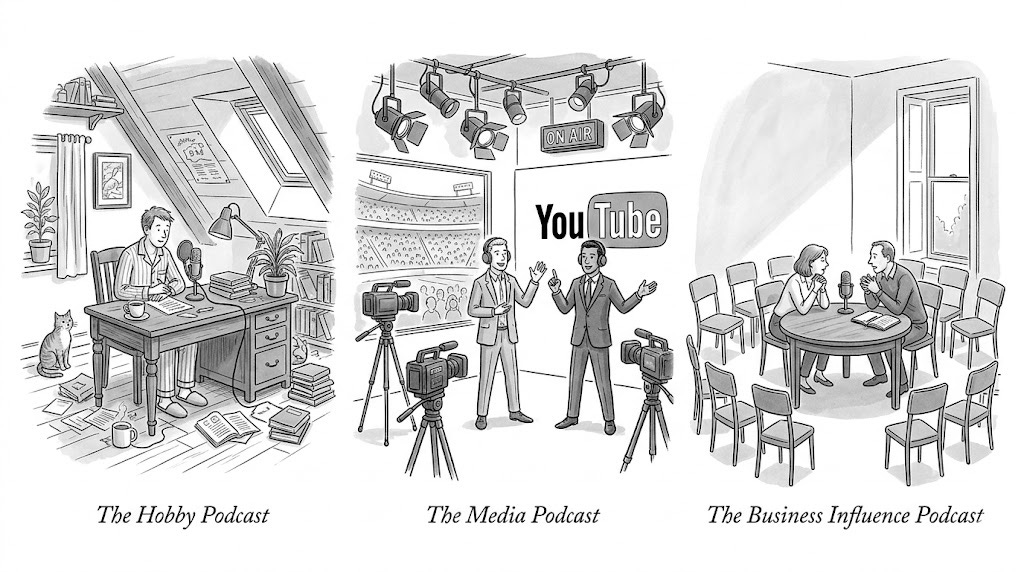
A critical mis-step for a Business Influence podcast is reading Media Podcast advice and acting on it.
A filter for everything you read
So when the Reuters report lands in your inbox, or any other piece of podcast research, run it through three questions…
Whose podcast is this advice for? If the source is talking about download charts, ad rates, or YouTube algorithm shifts, you are reading Media advice. If the source is talking about the right meeting, the right room, the right introduction, you are reading something closer to your model.
What translates? Plenty. The phrase the report leans on most is parasocial bond: the way a regular listener feels like they know Roman Mars, or Steven Bartlett, or Tim Ferriss, even though those hosts have no idea any one listener exists. (Not creepy. Just how humans respond to a trusted voice in their ear, going back to the radio era and probably to the storyteller around the fire.) That bond is real for Joe Rogan, and it is also real for the CEO interviewing six clients in the podcast studio. So is the discipline of treating one good story as a property that earns its keep multiple ways. So is the shift from slow turnaround to reactive content. All of that crosses over cleanly.
What will hurt my podcast if I copy it? Chasing download numbers will hurt you. Paywalling a small B2B audience will hurt you. Increasing ad density will hurt you. Building for the YouTube algorithm will hurt you. Each of these is a sensible answer to a Media Podcast question that you are not asking.
Norway is your tell
If you want to find your closest analogue inside the Reuters research, look at the Norway sections. Smaller market, public broadcaster dominance, slower video adoption, audiences that still default to audio for news. Bonnier News’ Martin Jönsson is admirably honest about the position: “we don’t really understand video podcasting yet.”
That honesty travels much better than a US-style “video or die” pivot. Reuters itself argues, gently, that the smaller the market, the less the headlong shift makes economic sense. South Africa is small. Your patch inside South Africa is smaller still.
Who are your fifteen?
The Reuters report is a detailed atlas of news publishing. You can read it. Underline it. Argue with it. Suárez calls the shift it describes “uneven”, and he is right. The deeper unevenness, the one his report is not in a position to reach, is the one between Reuters’ world and yours.
Or put the report down... and ask the question Newman and Suárez are not in a position to answer for you.
Who are your fifteen?
Most of you already know the answer. Your fifteen are the people whose attention compounds. The procurement director who has heard you describe a problem the same way three times and is starting to think you might be the person to solve it. The journalist who keeps your number for the days she needs an actual quote, not a press release. The non-executive director who said did you hear what so-and-so said on the podcast? over coffee on a Tuesday. The dozen other people who matter, who you can probably name on the back of an envelope.
Do not get distracted by promises of tricks and hacks that don’t even apply to your podcast
You do not need an atlas. You need a list.
Want help making your list?
If your podcast is a Business Influence podcast (and if you are reading this, it almost certainly is), the Solid Gold Podcast Masterclass is for you. One day. Six chairs. Adéle de la Reÿ and me. You leave with a strategy that is mapped to your business, a sixty-second trailer recorded on the day (proper studio mics, the lot), an episode blueprint, and a 30-day rollout plan with names against tasks.
Drop us a mail at masterclass@solidgold.co.za with the subject line “Map my podcast” and we will send you the date and the brief.
Let’s have an adventure.

Sources:
Newman, N. (2026). The Changing Shape and New Economics of News Podcasting. Reuters Institute for the Study of Journalism.
Suárez, E. (2026). Reuters Institute editorial summary email, 9 May 2026.
Kelly, K. (2008). 1,000 True Fans. The Technium. (Revisited version reprinted in Tim Ferriss’s Tools of Titans, 2016.)